


Artlayer3D
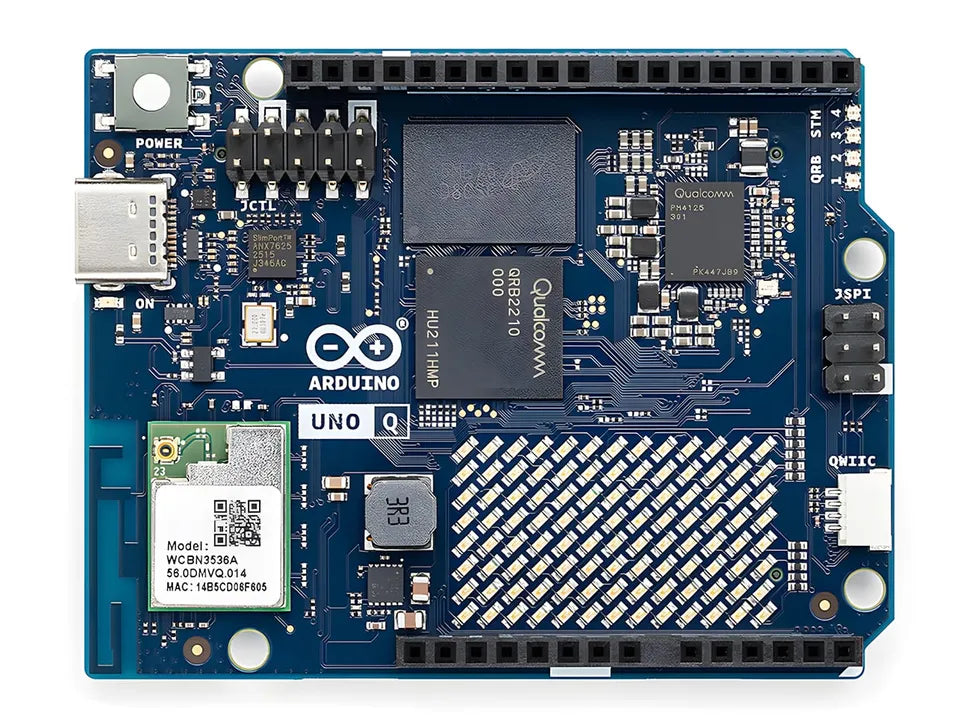
Arduino UNO Q Development Board with Qualcomm QRB2210 Processor
Arduino UNO Q Development Board with Qualcomm QRB2210 Processor
SKU:AL3D0713
In stock
Couldn't load pickup availability
Overview
Arduino UNO Q is a hybrid single-board platform that fuses a Debian Linux application processor with a real-time microcontroller — giving you the performance of a small computer and the timing accuracy of an MCU on one UNO-form-factor board.
At its core, UNO Q pairs a quad-core Qualcomm® Dragonwing™ QRB2210 (Arm® Cortex®-A53, 2.0 GHz) with an STM32U585 (Arm® Cortex®-M33, up to 160 MHz). Linux apps and Arduino sketches communicate over Arduino Bridge (RPC), so you can run high-level AI/vision or web services on Linux while the MCU handles deterministic control for motors, sensors, and I/O.
Key Features & Benefits
- Dual-core architecture: Combines a Linux-capable Qualcomm® Dragonwing™ processor with a real-time STM32U585 microcontroller for ultimate flexibility.
- AI & Vision Ready: Built-in Adreno 702 GPU, dual ISPs, and MIPI-CSI/DSI interfaces for cameras and displays — ideal for edge AI and machine vision projects.
- Seamless Development: Arduino App Lab lets you run Linux apps, Arduino sketches, and AI Bricks together from one environment.
- Full Connectivity: Dual-band Wi-Fi® 5, Bluetooth® 5.1, and USB-C® with DisplayPort Alt-Mode.
- Expandable Ecosystem: Standard Arduino UNO headers, Qwiic connector, and carrier board compatibility.
- Robust Power Options: USB-C (5 V/3 A) or VIN (7–24 V) with built-in protection and smart power routing.
- Modern Learning Platform: Perfect for education, prototyping, robotics, home automation, and edge computing.
Specification
Technical details for Arduino UNO Q Development Board with Qualcomm Dragonwing QRB2210 SoC.
| Specification | Details |
|---|---|
| Processor (MPU) | Qualcomm® Dragonwing™ QRB2210 SoC — 4× Arm® Cortex®-A53 @ 2.0 GHz |
| GPU / Imaging | Adreno 702 GPU @ ~845 MHz Dual ISPs up to 13 MP+13 MP or 25 MP @ 30 fps 4-lane MIPI-CSI-2 camera 4-lane MIPI-DSI display. |
| Microcontroller (MCU) | STMicroelectronics STM32U585 (Arm® Cortex®-M33 up to 160 MHz) 2 MB Flash & 786 kB SRAM |
| Memory / Storage | LPDDR4X: 2 GB or 4 GB eMMC: 16 GB or 32 GB (on-board). |
| Wireless | Dual-band Wi-Fi® 802.11a/b/g/n/ac (Wi-Fi 5) + Bluetooth® 5.1 (Qualcomm WCN3980/WCBN3536A) with shared PCB antenna. |
| USB-C | USB 3.1 with role switching DisplayPort Alt-Mode (via ANX7625). PD contract: 5 V up to 3 A (no higher-voltage profiles). When DP Alt-Mode is active, USB data rate may be reduced. |
| Headers & I/O |
JDIGITAL (3.3 V): SPI, I²C, UART, PWM, CAN; Arduino-style D0..D13 + extras. JANALOG (3.3 V): A0..A5 (ADC); IOREF (3.3 V), 5V, 3V3, GND, VIN (7–24 V); analog pins not 5 V-tolerant. Qwiic (3.3 V): I²C4_SDA/SCL for plug-and-play sensors/actuators. JSPI (3.3 V): MOSI/MISO/SCK JMEDIA (1.8 V + power): MIPI-CSI-2 / DSI, CCI I²C, camera clocks, VIN and 3V3 out. JMISC (mixed): MCU PSSI/SDMMC/TRACE/I²C4, OPAMP1, audio IO, 1.8 V MPU GPIO, +5V_USB/+3V3/+1V8, VBAT, VCOIN. JCTL (1.8 V): Console UART (SE4), boot/PMIC/reset control. |
| Analog | ADC referenced to VREF+ ≈ 3.3 V Valid input 0..VREF+ Absolute max ≈ VDD+0.3 V (~3.6 V). Use dividers/buffers for higher voltages. |
| CAN | FDCAN1 available on JDIGITAL pins (MCU domain, 3.3 V); external transceiver required. |
| Indicators | 2× RGB LEDs (Linux-controlled) 2× RGB LEDs (MCU-controlled; active-low) 8×13 blue LED matrix. Power LED (3.3 V rail). |
| Power Inputs | USB-C 5 V (up to 3A PD) and VIN 7–24 V (on header) |
| Operating Conditions | Voltage: USB-C 4.5–5.5 V; DC_IN 7–24 V. Ambient: −10 °C to +60 °C (continuous). |
| Dimensions / Form Factor | 68.58 mm × 53.34 mm UNO-compatible outline, hole pattern, and stacking; bottom components ≤ ~2 mm for carrier clearance. |
| Software & Tools | Debian Linux (MPU) + Arduino Core on Zephyr (MCU) Arduino App Lab with “Bricks” for AI/web/integrations Bridge RPC for Linux↔MCU. |
| Video Output | DisplayPort Alt-Mode over USB-C (via ANX7625; source from MPU MIPI-DSI). |
| Camera | MIPI-CSI-2 (4-lane) in 1.8 V domain; dedicated CCI I²C and MCLK lines (not general-purpose GPIO). |
| Power Button | Long-press (≥5 s) reboots Linux (does not cut board power). |
| Variants | ABX00162: 2 GB RAM / 16 GB eMMC; ABX00173: 4 GB RAM / 32 GB eMMC. |
Compare
Arduino UNO Q vs Raspberry Pi 5 vs Portenta H7 vs NVIDIA Jetson Orin Nano
| Specification | Arduino UNO Q | Raspberry Pi 5 | Arduino Portenta H7 | NVIDIA Jetson Orin Nano |
|---|---|---|---|---|
| Processor | Qualcomm® Dragonwing™ QRB2210 (4× Arm Cortex-A53 @ 2.0 GHz) | Broadcom BCM2712 (4× Arm Cortex-A76 @ 2.4 GHz) | ST STM32H747 (Cortex-M7 + Cortex-M4) | 6-core Arm Cortex-A78AE + 1024-core Ampere GPU |
| Operating System | Debian Linux + Zephyr (dual-OS) | Raspberry Pi OS (Linux) | Arduino Core + Mbed OS | Ubuntu 20.04 + JetPack SDK |
| GPU | Adreno 702 @ 845 MHz | VideoCore VII @ 800 MHz | None | 1024-core Ampere GPU (Orin) |
| Memory / Storage | 2 GB / 4 GB LPDDR4X + 16 GB / 32 GB eMMC | 4 GB / 8 GB LPDDR4X + microSD | 1 MB Flash + 1 MB RAM | 8 GB LPDDR5 + eMMC 128 GB (optional) |
| Wireless | Wi-Fi 5 (dual-band) + Bluetooth 5.1 | Wi-Fi 5 + Bluetooth 5.0 | Optional Wi-Fi / BLE Module | Gigabit Ethernet / Wi-Fi (through dongle) |
| Video Output | DisplayPort Alt-Mode via USB-C (DSI→DP) | 2× micro HDMI (4K) | None (uses external display modules) | 1× HDMI 2.1 + MIPI DSI |
| I/O Voltage | 1.8 V (MPU) + 3.3 V (MCU) | 3.3 V logic | 3.3 V logic | 1.8 V / 3.3 V mixed |
| Typical Use Case | AI + Real-time control (dual processor) | General Linux computing and education | Industrial IoT and embedded control | Edge AI and robot vision projects |
| Power Input | USB-C 5 V (3 A) / VIN 7–24 V | USB-C 5 V (5 A) | VIN 5–18 V / USB-C 5 V | Barrel Jack 19 V / USB-C PD |
| Form Factor | Arduino UNO (68.6 × 53.3 mm) | Credit card (85 × 56 mm) | Portenta (66 × 25 mm) | Developer Kit (100 × 79 mm) |
| Ideal For | Edge AI education, robotics, IoT with Linux + MCU | Hobby projects and general Linux use | Industrial control and prototyping | High-performance AI inference and vision |
Share


-
GST Invoice
-
Ship from Mumbai, MH
Bulk Order
Contact sales on WhatsApp and get bulk order discount! Or mail us on support.